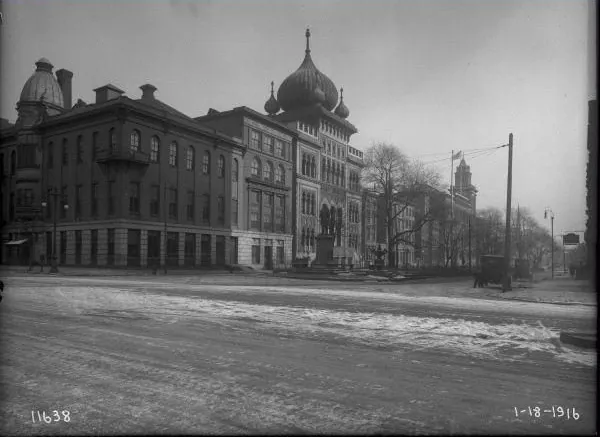
One of Philadelphia’s most dynamic cultural and industrial crossroads — where North Broad’s boulevard ambition meets the Spring Garden Street corridor.
Historic Photo Timeline
Archival photographs and prints documenting the intersection’s transformation — from Odd Fellows Hall and Baldwin Works to Automobile Row, the State Office Building, and civic life at the corner. Click a photograph to enlarge it.
1681 Thomas Holme surveys Broad Street as a primary artery of William Penn’s plan.
1830s Matthias Baldwin establishes locomotive works at Broad & Spring Garden.
1854 Act of Consolidation brings the District of Spring Garden into the City of Philadelphia.
Mid-1800s Odd Fellows’ Broadway Hall stands at the southeast corner.
1892 Baldwin Locomotive Works dominates the southwest Broad Street frontage.
1924–1928 Broad Street Subway / Spring Garden Station constructed.
1942 Red Cross Motor Corps mobilizes at the intersection during World War II.
1955 Architect’s model shows the Commonwealth Building raised on piers at Broad & Spring Garden.
1958 Philadelphia State Office Building opens on the southwest corner.
1963 Evening Bulletin photographs record noon traffic from the building’s 18th floor.
1965 Community College of Philadelphia opens on Spring Garden (former U.S. Mint).
1975 Day-care funding protest fills the intersection.
1998 Meg Saligman’s Common Threads mural completed.
Colonial & Early American Origins (1681–1820s)
The street grid
When surveyor Thomas Holme laid out William Penn’s plan for Philadelphia in 1681, Broad Street was designated as one of two primary broad arteries (alongside High Street, now Market Street).
Springettsbury Farm
The area surrounding Spring Garden Street was originally part of Springettsbury Farm, a large country estate belonging to William Penn and his descendants.
Outside city limits
During the colonial and early national eras, Spring Garden sat north of Philadelphia proper (then Vine Street to South Street) as a rural district of estates, gardens, and farmland.
The Industrial Age & Baldwin Locomotive Works (1830s–1900)
Industrial transformation
In the early 1830s, Matthias Baldwin established his locomotive factory at Broad and Spring Garden Streets. Baldwin Locomotive Works grew into the world’s largest manufacturer of steam locomotives, occupying several square blocks on the southwest side of the intersection along North Broad.
Economic powerhouse
Tens of thousands of skilled mechanics, engineers, and laborers worked nearby, driving rapid urbanization around the intersection.
Odd Fellows’ Broadway Hall
Mid-19th-century lithographs show the I.O.O.F. hall on the southeast corner — fraternal life sharing the crossroads with booming industry.
District consolidation
In 1854, the Act of Consolidation formally integrated the District of Spring Garden into the expanded city of Philadelphia.
From locomotives to automobiles
As manufacturing shifted, North Broad filled with showrooms, finance offices, tire dealers (including Lee Tires and Kelly Tires), and trolley-served commercial blocks — “Automobile Row.”
Elmer Harold Wolf Chevrolet
By the late 1940s the northwest corner carried a full Chevrolet dealership, rooftop billboard clock, and constant traffic directed by officers in the intersection.
Subway era
Construction of the Broad Street Line (1924–1928) locked in Spring Garden Station as a primary North Philadelphia transit node, visible in 1926 decking photos and the 1941 subway entrance streetscape.
Wartime mobilization
In November 1942, American Red Cross Motor Corps volunteers lined ambulances at Broad & Spring Garden near the Dreer Seeds building — the corner as a wartime staging ground.
Mid-Century Community & Modern Renewal
State Office Building (1958)
A May 1955 architect’s model showed the $7 million Commonwealth Building — white marble, lifted on piers over a landscaped plaza — for the block bounded by Broad, Spring Garden, Buttonwood, and 15th. After mid-century clearance near the Inquirer complex, the International Style State Office Building rose on the southwest corner — later adapted into Tower Place / 1400 Spring Garden lofts.
Views from the 18th floor (1963)
On January 23, 1963, Evening Bulletin photographer Jack Tinney looked down from the State Office Building: noon traffic along Broad Street, and a quieter view east along Spring Garden toward the Delaware River, with a Philadelphia National Bank billboard in the foreground.
Philadelphia’s first barrio
In the 1950s–60s, Spring Garden became a hub for Puerto Rican migrant communities, Latino culture, and activism.
Community College of Philadelphia
CCP established its primary campus in 1965 west of Broad on Spring Garden in the former U.S. Mint building.
1975 day-care protest
Demonstrators blocked the intersection for hours while marching between City Hall and the State Office Building to oppose day-care funding cuts — civic life playing out in the street itself.
Common Threads (1998)
Mural Arts Philadelphia commissioned Meg Saligman to paint Common Threads on the former Thaddeus Stevens School — still one of the city’s most iconic murals.
Adaptive reuse & high-rises
Industrial buildings became lofts; North Broad added transit-oriented towers, retail, and renewed cultural venues.